August 19, 2026
Two Liberos – FAQs
NEW RULE: A team may designate zero, one or two liberos, but only one libero can be in the game at a time.
UNIFORMS
Q. Can the liberos wear two different uniform colors?
A. Yes – Each libero may wear a different color uniform, if both libero uniforms clearly contrast with non-libero teammates.
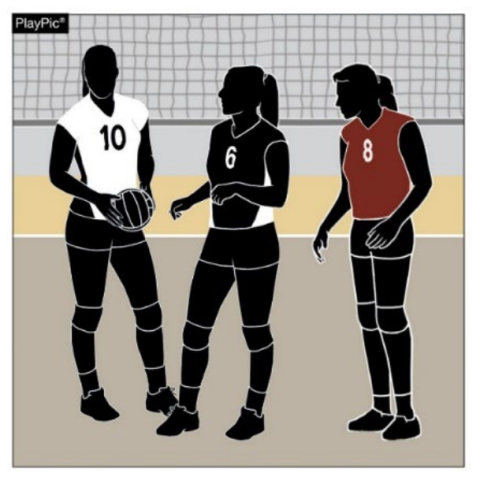
SITUATION 1: The team is wearing white uniforms, the L1 is wearing black, and the L2 is wearing red. RULING: Legal. (4-2-2a)
SERVING
Q. Can both liberos serve?
A. Yes, but they are tied to the same serving position.
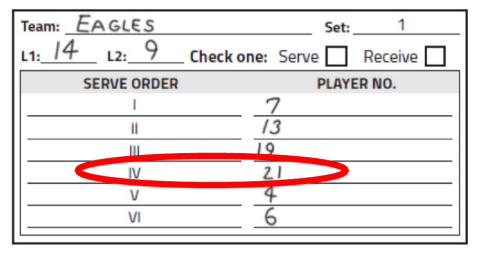
SITUATION 2: L1 serves in position IV on the lineup. After L1 scores three points, the L2 exchanges for the L1 and serves two more points. RULING: Legal. (10-4-1a, 10-4-5a)
SITUATION 3: L1 replaces No. 21 and serves in position IV. Two rotations later, L2 replaces No. 6 and prepares to serve in the sixth position. RULING: Illegal. COMMENT: L2 completes an illegal libero replacement by replacing someone other than No. 21 in the serving position. The L1, L2 and No. 21 are tied to that serving position and it is an illegal replacement if the L1 or L2 attempt to enter the set for another player in position to serve.
An unnecessary delay (administrative yellow card for the first offense or administrative red card for a subsequent offense in that set) is charged to Team S if identified before contact for serve. If identified after contact for serve, an illegal alignment (loss of rally/point) results. (10-4-1a, 10-4-5a, 10-4 PENALTIES 1)
TRACKING
Q. Does the libero tracker have to track all exchanges?
A. No, it does not matter which libero is in the set.
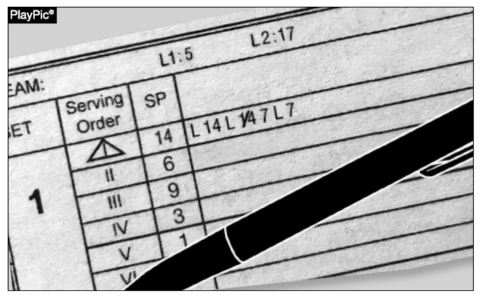
SITUATION 4: Team S lists two liberos at the top of the scoresheet and libero tracking sheet. During the first set, L1 completes a libero replacement for No. 14. The libero tracker marks an “L” on the line next to player No. 14. A few points later, L2 exchanges with L1. Nothing is recorded by the libero tracker. When player No. 14 replaces L2, the libero tracker enters the player number next to the “L”. RULING: Correct libero tracker procedure.
COMMENT: If a libero exchanges with another libero, there is nothing to record on the libero tracking sheet. The libero tracker is only tracking libero and player replacements. The scorer will indicate with a circle the first entry for each libero into the set. (5-7-1b, Instructions for Libero Tracker).
Q. How do I ensure that the same libero is on the court after a time-out?
A. The officials should discuss during their prematch meeting how they want to note which libero is in the set when a time-out is called. The R2 can note the number of the libero in the set on their lineup card or ask the libero tracker to make a note.
DESIGNATING
Q. If numbers 2 and 7 are liberos for the first set, can new liberos be designated for the second set?
A. Yes, just like with one libero – they can change each set.
SITUATION 5: Player Nos. 2 and 7 are designated as L1 and L2 in set one. In set two, player Nos. 3 and 4 are designated as L1 and L2. RULING: Legal.
Q. When a team designates two liberos in the first set and one is disqualified, the team must play with one libero for the remainder of that set, can they list two liberos for the second set?
A. Yes, for subsequent sets, the team may designate up to two liberos.
SITUATION 6: Team S designates Nos. 2 and 7 as L1 and L2 in set one. No. 7 is disqualified. Team S plays the remainder of set one with one libero. Team S designates Nos. 2 and 4 as L1 and L2 in set two. RULING: Legal. COMMENT: Player No. 7 is disqualified for the remainder of the match. Lineups reset after each set and allow up to two liberos to be designated.
Case Book Correction: 10.4.3 SITUATION F: COMMENT: When a libero is disqualified the team may not re-designate a new libero. If a team has only designated one libero, the match set will continue with no liberos. If a team designates two liberos, the match set will continue with one libero.
REPLACEMENTS/EXCHANGES
Q. Can a libero replacement and exchange occur during the same dead ball?
A. Only when the L1 is moving directly to the serving position and the L2 will serve.
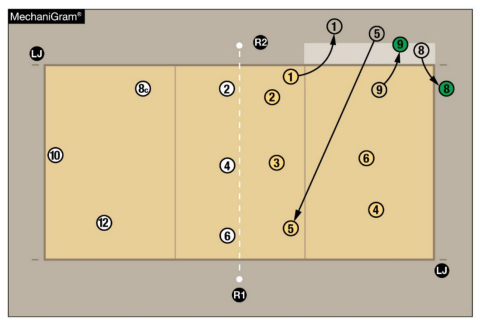
SITUATION 7: Team R wins the rally and the L1 (No. 9) completes a libero exchange with L2 (No. 8) who assumes the serving position. The entering position player (No. 5) completes a replacement with the exiting position player (No. 1). RULING: Legal. COMMENT: A replacement and an exchange can occur on the same dead ball when a libero is replacing the player serving in the right back position without leaving the court. (10-4-1d)