Our Mission

Welcome to the web home of the Northeast Chapter # 2 of the New Jersey Volleyball Officials Association

TO BECOME A REFEREE, CLICK HERE.

The following are the purposes for which this organization has been organized:

To promote the welfare of the games of volleyball on the county level by uniformly interpreting and administering the rules of those games as set forth by the New Jersey State Interscholastic Athletic Association (NJSIAA) and the National Federation of High School Sports (NFHS);

To promote and maintain the highest degree of volleyball officiating by following a uniform set of mechanics;

To have available at all times an adequate number of thoroughly trained and capable officials.

To preserve the traditions, foster the ideals, advance the interests and improve the quality and prestige of the volleyball referees through a comprehensive program of recruitment, classroom training, and on-the-court experience;

To develop a spirit of friendship and maintain a high standard of ethics among officials.

Five Ways to Enhance the Volleyball Officiating Experience

Republished from Referee Magazine - September 10, 2025
By Michael Flowers

Know Your Role

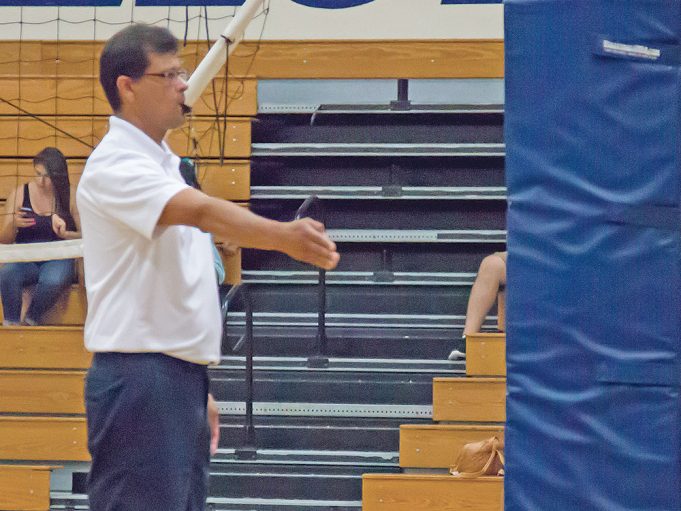
When people think of volleyball referees, they often imagine someone simply blowing a whistle and calling faults. Volleyball is no different in this perception — the official standing courtside or on the stand, raising a hand when something goes wrong.

But the reality is far richer. Referees are essential in ensuring the game runs smoothly, fairly, and safely. Beyond enforcing the rules, they set the tone, guide player development, and preserve the integrity of the sport. Having officiated countless matches, I can confidently say our role is far more than just calling errors — it’s about keeping the game in balance.

1. Set the Tone

From the first whistle, the referee establishes the atmosphere of the match. Players, coaches, and fans all take cues from the official’s demeanor. A calm, consistent approach communicates professionalism, while hesitation or aggressiveness can shift the entire mood.

I learned early in my career that firmness paired with clear communication builds trust. When players know the referee is fair, they can focus entirely on the game.

2. Ensure Fair Play

Rules keep the game grounded in fairness. In a fast-paced sport like volleyball, it’s easy for players to slip into habits that stretch the rules — from foot faults on serves to incorrect rotations. Every decision, no matter how small, shapes the match’s integrity.

I still recall a critical net violation call at match point early in my career. The pressure was enormous, but making the right call reinforced the idea that rules apply to everyone.

3. Think Safety First

Volleyball’s intensity brings risk — high jumps, quick reflexes, and fast collisions. Referees are the first line of defense in maintaining safety. That includes ensuring equipment is correct and halting play when situations look dangerous.

I’ve had to stop matches out of concern for players’ well-being, even when no rule was technically broken. In those moments, protecting athletes takes precedence over everything else.

4. Support Player Development

Officiating isn’t just about calling errors; it’s also about helping players grow. A whistle for a double contact or a net violation often sparks immediate adjustments in technique.

Over the years, I’ve had players thank me after matches for calls that made them aware of habits they hadn’t noticed. Referees, in this way, contribute directly to the evolution of the sport.

5. Stay Neutral and Professional

Perhaps the greatest challenge is maintaining composure amid the noise of competition. Coaches, fans, and players will all have opinions — sometimes loudly. The referee’s job is to remain steady, neutral, and professional no matter what.

Consistency earns respect and teaches everyone that respect for the game comes before everything else.

Conclusion

We do far more than blow a whistle. Referees are the backbone of every volleyball match: guiding the flow of the game, ensuring fairness, maintaining safety, supporting development, and upholding integrity.

The next time you raise your hand to call a fault, remember the importance of that action — it reflects the countless responsibilities wrapped into one role.
Coaching Protocols and Jewelry Allowances Highlight 2023-24 Volleyball Rules Changes

The expansion of the coaching zone beyond the end line of the volleyball court and the allowance of one assistant coach to stand and communicate with players headline the new 2023-24 high school volleyball rules changes.

In all, five rules changes were recommended by the National Federation of State High School Associations (NFHS) Volleyball Rules Committee at its annual meeting January 8-10. All rules changes were reviewed and approved by the NFHS Board of Directors.

Rule 2-1-9 was added to define the coaching zone as the area from the libero replacement zone to the area beyond the end line and the sideline extended. In addition to head coaches utilizing the coaching zone, Rule 12-2-6 was changed to allow one assistant coach to stand within the coaching zone during dead-ball situations. The assistant coach standing within the coaching zone may change throughout the match. All other assistant coaches must remain seated.

“The committee felt it was necessary to better define the space in which coaches are allowed to stand and instruct both players on the floor and on the bench while also providing some flexibility for specialized coaching by assistant coaches during dead-ball situations,” said Lindsey Atkinson, NFHS Director of Sports and liaison to the Volleyball Rules Committee.

The wearing of jewelry by players is addressed in a change to Rule 4-1-7, which now states that all jewelry must be removed, except small, secured studs or posts worn above the chin. No jewelry is permitted below the chin, including string bracelets, commemorative bracelets and body jewelry. In addition, taping over jewelry is not permitted. This rules change aligns high school rules with NCAA rules on the wearing of jewelry.

“Other NFHS and volleyball rules codes have been addressing the allowance of jewelry over recent years,” Atkinson said. “The committee’s decision to align with NCAA volleyball jewelry rules was to both minimize the risk of injury by limiting the type and location of jewelry and create consistency for officials and student-athletes.”  

Beginning in 2028, uniform numbers with a leading zero will not be permitted. This change to Rule 4-2-4b eliminates confusion when signaling numbers and aligns NFHS rules with other rules codes.

The procedure for requesting a substitution was amended in Rule 10-2-1. The head coach may now verbally request a substitution to an official in addition to visually signaling.

A complete listing of the volleyball rules changes will be available on the NFHS website at www.nfhs.org. Click on “Activities & Sports” at the top of the home page and select “Volleyball.”

According to the most recent NFHS High School Athletics Participation Survey, volleyball is the second-most popular sports for girls (trailing track and field) with 454,153 participants in 16,532 schools nationwide. In addition, there are 66,487 boys participating in the sport at 2,682 schools.


Pages